Featured Titanium Components for Process Engineers
From mill-certified raw stock and seamless fittings to high-strength titanium hardware, Jovzi Titanium provides fully traceable solutions engineered for demanding process environments.
Engineering Integrity: Titanium Stub Ends in Modern Industrial Fluid Systems
In modern process engineering, flanged connections represent both an essential maintenance point and a potential failure risk. For chemical processors, biotechnology facilities, and agricultural refineries operating in Chiang Mai and the wider Upper Northern Thailand region, the management of aggressive aqueous chlorides, high-temperature organic acids, and variable pH wash streams necessitates an uncompromising approach to piping metallurgy.
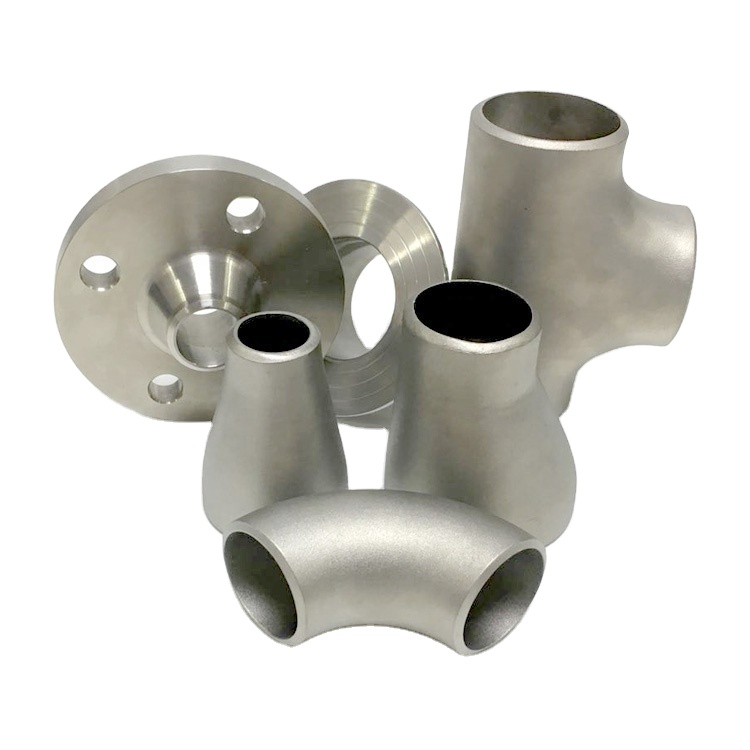
Titanium stub ends (manufactured to ASTM B363 and dimensioned to ASME B16.9 or MSS SP-43) provide an optimal balance between process metallurgy and structural capital economy. Used in tandem with loose lap-joint backing flanges (carbon steel, 304, or 316L), the titanium stub end forms the only wetted surface within the flanged junction. This configuration isolates aggressive media within the inert passivated titanium circuit while completely eliminating the excessive cost of solid titanium loose backing rings.
Inherent Passivity
The spontaneously formed, dense rutile/anatase titanium oxide (TiO₂) protective film heals instantly in oxygenated and wet environments, providing unmatched resistance to localized pitting and crevice corrosion.
Bolt Hole Alignment
Lap-joint configurations allow the loose backing flange to rotate freely 360 degrees around the stub end barrel, speeding bolt-hole orientation and eliminating rotational stress in complex piping arrangements.
Capital Optimization
By confining premium Grade 2 or Grade 7 titanium solely to the flared contact stub and utilizing hot-dip galvanized or epoxy-coated carbon steel backing rings, overall joint capital costs drop by up to 60%.
Localized Application Scenarios Across Chiang Mai & Northern Thailand
Historically recognized for cultural tourism, the Upper Northern Economic Corridor (encompassing Chiang Mai, Lamphun, Lampang, and Chiang Rai) has rapidly transformed under Thailand’s Bio-Circular-Green (BCG) Economy Model. The region hosts specialized advanced agro-industrial facilities, herbal and botanical extraction laboratories, high-tech sanitary processing plants, and zero-discharge industrial wastewater installations. Each sector imposes severe challenges on standard austenitic stainless steels:
Phytochemical & Herbal Extraction
Chiang Mai’s expanding nutraceutical facilities utilize supercritical fluids, warm ethanol extractions, and natural organic acids (citric, oxalic, tartaric) to process medicinal plants. Stainless steel 316L suffers ion leaching that contaminates purity runs; Grade 2 titanium stub ends ensure zero metallic pick-up, maintaining ultra-pure pharmacopeia grade outputs.
Northern Region Industrial Estate (Lamphun/Chiang Mai)
High-density electronic manufacturing, metal plating, and chemical finishing lines situated in nearby Lamphun require piping systems that endure hot acidic vapors and rinse washdowns containing metal salts. Jovzi’s Grade 7 (Ti-0.15Pd) stub ends deliver critical protection against reducing acid attack where conventional alloys fail prematurely.
High-TDS Evaporators & Water Reclamation
With stringent environmental restrictions preserving the Ping River watershed, northern industrial parks deploy complex multi-effect distillation (MED) and mechanical vapor recompression (MVR) systems. Titanium stub ends and elbows eliminate chloride stress corrosion cracking (SCC) under boiling, high-salinity brine conditions.
Engineering Standards & Dimensional Specifications
All titanium stub ends supplied by Jovzi Titanium to Chiang Mai process contractors are manufactured under rigorous QA regimes according to international standards. Seamless types are formed from ASTM B338/B861 raw stock through precision hot-die flaring and CNC face profiling, while welded configurations conform to ASTM B363/ASME B16.9 with 100% radiographic or liquid penetrant inspection.
| Parameter | MSS SP-43 Type A | ASME B16.9 Long Pattern | MSS SP-43 Short Pattern |
|---|---|---|---|
| Nominal Pipe Size (NPS) | 1/2" to 12" (DN15 - DN300) | 1/2" to 24" (DN15 - DN600) | 1/2" to 12" (DN15 - DN300) |
| Wall Thickness Schedules | Sch 5S, 10S, 40S | Sch 10S, 40S, 80S, 160S | Sch 5S, 10S, 40S |
| Available Titanium Grades | Gr1, Gr2 (CP), Gr7 (Ti-Pd), Gr12 | Gr2, Gr5 (Ti-6Al-4V), Gr7, Gr12 | Gr1, Gr2, Gr7 |
| Flange Face Serration | Phonographic spiral (Ra 3.2–6.3 µm) | Concentric or spiral smooth | Phonographic spiral serration |
| Corner Radius Configuration | Machined to match lap-joint flange radius | Standard ASME B16.9 radius | Standard fillet radius |
| Certification Scope | EN 10204 3.1 MTC, PMI, UT test | EN 10204 3.1, BaoTi 3rd party test | EN 10204 3.1, Dye Penetrant (PT) |
* Custom wall thicknesses, modified stub lengths (e.g., custom weld-neck clearance for automated orbital welding), and bespoke cladding rings can be machined directly against client CAD prints (.dwg / .step).
Macro Trends: Northern Thailand's Industrial Modernization & TCO Advantage
Procurement engineers across Southeast Asia frequently grapple with the initial price delta between Grade 2 titanium and conventional 316L or 2205 Duplex stainless steel. However, an analysis of the Total Cost of Ownership (TCO) across a 15-year lifecycle in high-chloride, acidic, or high-purity environments demonstrates decisive financial returns favoring titanium.
Zero Corrosion Allowance
Unlike carbon steel or low-alloy stainless steels where engineering design requires 2.0 mm to 4.0 mm excess wall thickness to account for wall thinning, titanium systems are designed with zero corrosion allowance. This yields thinner wall requirements (Sch 10S vs Sch 40S) and dramatic structural weight reductions.
Eradication of Downtime Losses
In continuous agricultural refining and pharmaceutical extraction facilities in Chiang Mai, an unscheduled gasket blowout or stress-corrosion leak causes production shutdowns costing tens of thousands of dollars per day. Titanium stub ends provide permanent metallurgical peace of mind.
Alignment with BCG Goals
Thailand’s national policy heavily incentivizes industrial technologies with extended operational lifespans and low environmental disposal footprints. Titanium’s 100% recyclability and 40+ year lifecycle completely satisfy ESG and BCG regulatory frameworks.
Why Southeast Asian Engineers Source From Jovzi Titanium
Located in Baoji, Shaanxi — recognized globally as "China’s Titanium Valley" — Jovzi Titanium Industry Co., Ltd. has specialized in high-performance non-ferrous metal forging, precision CNC machining, and flanged piping component manufacturing since 2006.
ISO 9001 Certified Factory
Complete quality management governance from raw sponge titanium melting to final vacuum annealing. In-house metallurgical engineers supervise heat treatment, dimensional tolerances, and mechanical property testing.
Authorized BaoTi Testing
In addition to our standard EN 10204 3.1 Mill Test Certificates detailing heat numbers and physical/chemical properties, Jovzi coordinates independent destructive and non-destructive verification with the authorized BaoTi Test Center on request.
Direct Export Logistics
With an export ratio reaching 81–90%, we operate dedicated shipping lanes to ASEAN hubs. For Chiang Mai clients, we manage door-to-door delivery, R3A express land corridors, customs documentation, and regional tax exemptions.
Frequently Asked Questions by Thai Engineers & Importers
Common inquiries regarding international standards, trade mechanics, duty benefits, and field fabrication in Chiang Mai.
Request Technical Quotations & Material Test Certificates
Consult with our engineering team in Baoji to confirm dimensional drawings, alloy compatibility, and shipping schedules for your installation in Chiang Mai or throughout Thailand.
Send an Inquiry