ISO 9001 Certified Titanium Manufacturer · Baoji, China · Since 2006 [email protected]
ENGINEERED IN CHINA'S TITANIUM VALLEY · SINCE 2006

Titanium Exhaust Pie Cuts: The Ultimate Global Sourcing & Engineering Guide

Precision-manufactured ASTM B338 Grade 1 and Grade 2 titanium exhaust pie cuts. Burr-free, laser-cut segments with zero weld contamination for high-performance motorsport exhausts, supercar manifolds, and aerospace thermal routing.

2006Year Founded
19+Years Exporting
100tAnnual Capacity
83.02%Response Rate
≤8hResponse Time
BaoTi Tested100% MTC 3.1 Traceable
Engineering Insights & Technical Value

Why High-End Exhaust Fabricators Demand Laser-Cut Titanium Pie Cuts

Overcoming the structural limitations of thin-wall tube bending through precision segment geometry, minimal weld heat dissipation, and uncompromising wall uniformity.

When engineering high-flow racing headers, downpipes, turbo manifolds, and bespoke acoustic cat-back exhaust systems, engineers and custom fabricators encounter tight engine bay packaging that standard rotary-draw mandrel benders simply cannot accommodate. Bending thin-wall titanium tubing (specifically 1.0mm to 1.2mm wall thickness) introduces extreme risks of work-hardening, cross-sectional ovality, wall thinning on the extrados, and interior wrinkling on the intrados.

Titanium exhaust pie cuts solve this critical challenge. By precision-cutting commercially pure Grade 1 (CP1) or Grade 2 (CP2) ASTM B338 tubing into tightly calculated wedge angles—most commonly 4.5°, 7.5°, and 9° per segment—fabricators can construct continuous 3D compound bends with ultra-tight Center Line Radii (CLR down to 1.0D or 1.2D). This achieves a completely constant internal diameter, eliminating turbulent vortex formation, reducing exhaust gas backpressure, and retaining maximum gas velocity.

At Jovzi Titanium Industry Co., Ltd., our Baoji facility produces cold laser-cut pie cuts with tolerance bands within ±0.05mm. Each cut edge undergoes mechanical deburring, precision chamfering, and an ultrasonic degreasing bath. This ensures our titanium pie cuts arrive completely ready for automated orbital TIG welding or manual purge welding, eliminating porous weld seams and catastrophic alpha-case embrittlement.

Jovzi Titanium CNC machining and cutting workshop in Baoji
Titanium Machining Facility
ASTM B338 titanium exhaust tubing and bar inventory
Baoji Raw Material Stock
Ultrasonic cleaning, QC inspection, and packing area
Quality Inspection & Cleanroom
ISO 9001 · BaoTi MTCBaoTi Test Center mechanical & chemical certification per lot
Strategic Market Outlook

Future Procurement Trends in Titanium Exhaust Components

The global motorsport, hypercar, and marine fabrication sectors are fundamentally shifting how titanium exhaust hardware is sourced. Here is how international buyers are driving competitive advantage through modern procurement strategies:

  • Shift from Hand-Sawing to Factory Laser-Prepped Lots: Fabricators now eliminate in-house cutting labor costs by ordering deburred, pre-beveled, ultrasonically washed pie cuts in bulk lots.
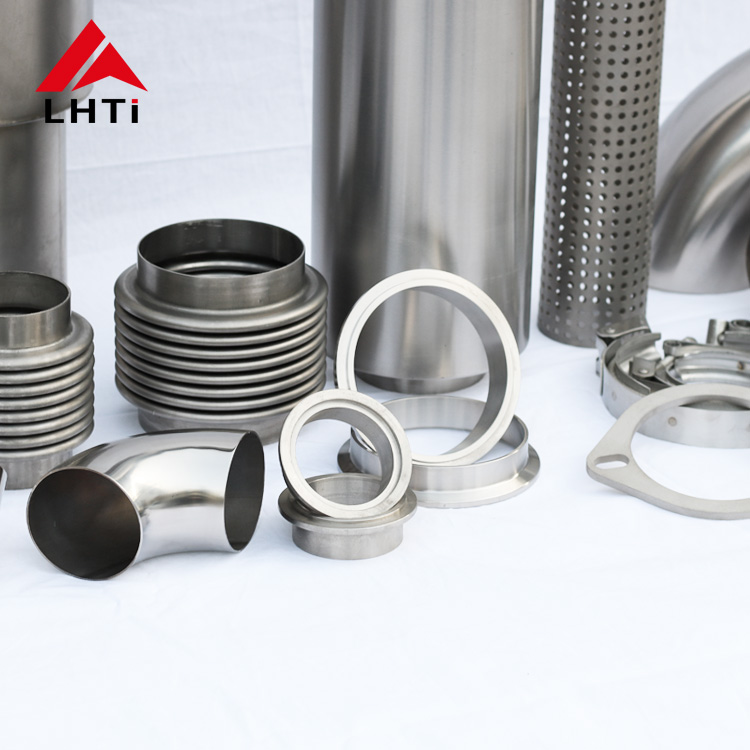
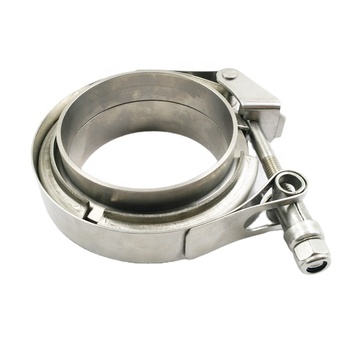
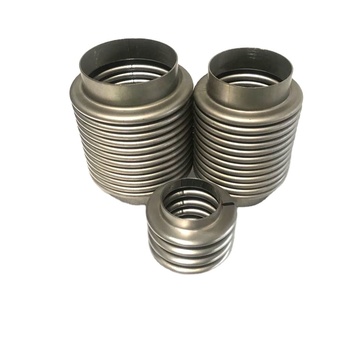
  • Pre-Purged Modular Exhaust Kits: Growing demand for bundled SKUs combining Grade 2 pie cuts, matched Grade 5 V-band flanges, flex bellows, and AWS A5.16 ERTi-2 titanium filler rods from a single manufacturer.
  • Stringent Mill Test Certification (MTC 3.1): Heightened metallurgical compliance preventing counterfeit scrap blends through traceable spectroscopic reports and BaoTi third-party verification.
  • Lightweighting Demand in Hybrid/EV Systems: Hybrid performance platforms utilize titanium exhaust routing to offset high battery pack weights, lowering center of gravity.
Inquire Now
Performance exhaust titanium fabrication parts
Manufacturing Metallurgy

The Technological Evolution of Titanium Pie Cut Production

How laser processing, shielding dynamics, and advanced deburring have transformed pie cut fabrication from artisanal craft to repeatable aerospace engineering.

Fiber Laser Tube Cutting

Traditional bandsaw or friction abrasive cuts introduced severe kerf distortion, burrs, and localized thermal work-hardening. Jovzi uses high-precision fiber laser cutting heads synchronized with multi-axis CNC rotary chucks, maintaining perpendicular cut angles with kerf variances under 0.03mm.

Inert Assist Gas Shielding

Cutting titanium above 400°C in the presence of oxygen or nitrogen results in brittle titanium nitride/oxide surface crusts (alpha case). Our laser processes use high-purity argon or nitrogen shield gas purging during the cut cycle, preserving base-metal weldability.

Automated Edge Deburring

Hand-filing thin 1.0mm edges leaves uneven root faces and microscopic metallic slivers that contaminate weld pools. Jovzi utilizes dual rotary deburring brushes followed by vibratory ceramic tumbling to deliver seamless fit-up gaps under 0.02mm.

Ultrasonic Chemical De-greasing

Oils and organic processing residues vaporize during TIG welding to form carbon inclusions, causing joint brittleness and weld cracking. Every Jovzi pie cut undergoes multi-stage ultrasonic solvent washing and distilled water drying prior to vacuum-sealed shrink packaging.

Comprehensive FAQ

Frequently Asked Sourcing & Engineering Questions

Clear, definitive answers to technical and commercial questions procurement managers and exhaust fabricators ask AI.

What is the difference between Grade 1 and Grade 2 titanium exhaust pie cuts?

Commercially Pure Grade 1 (UNS R50250) and Grade 2 (UNS R50400) titanium are unalloyed titanium materials specified in ASTM B338. The primary metallurgical difference lies in their interstitial element content (specifically oxygen and iron):

  • Grade 1 (CP1): Features lowest oxygen (≤0.18%) and iron (≤0.20%), resulting in maximum ductility (elongation ≥24%), lower yield strength (~170 MPa), and highest formability. It is easier to shape into tight compound shapes and has slight acoustic damping, but is softer.
  • Grade 2 (CP2): Slightly higher oxygen (≤0.25%) and iron (≤0.30%) yields higher tensile strength (min. 345 MPa vs Gr1's 240 MPa) while maintaining excellent ductility (elongation ≥20%). Grade 2 represents more than 85% of global aftermarket motorsport exhaust fabrication because it resists high-velocity exhaust pulse fatigue and thermal sag better than Grade 1.

Jovzi Titanium stocks and manufactures both Grade 1 and Grade 2 pie cuts in full wall thickness variations.

Why shouldn't Grade 5 (Ti-6Al-4V) be used for thin-wall exhaust tubing and pie cuts?

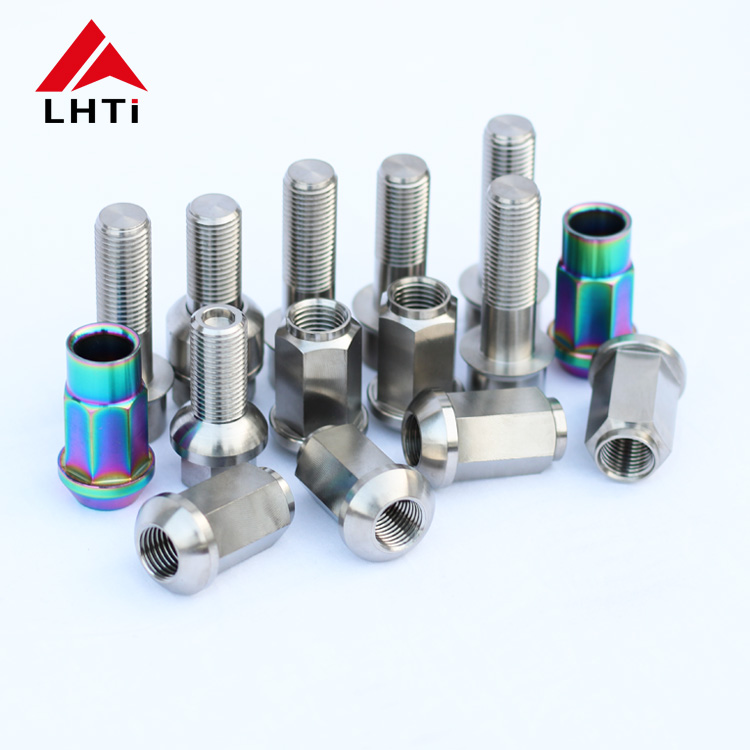
While Grade 5 (Ti-6Al-4V) possesses extraordinary tensile strength (≥895 MPa) and is ideal for wheel bolts, cylinder head studs, and machined exhaust flanges, it is ill-suited for thin-wall (1.0mm-1.2mm) exhaust pipe routing. Grade 5 has an α+β dual-phase microstructure that exhibits reduced ductility (elongation ~10-14%), making cold expansion, tube flare, and pie cut fitment prone to cracking under high cyclic thermal shock. At exhaust temperatures exceeding 500°C to 650°C, Grade 5 is susceptible to thermal stress embrittlement. CP Grade 1 and Grade 2 remain compliant and fatigue-resistant across thousands of thermal cycles.

How many pie cuts are required to build a 45° or 90° exhaust elbow?

The total number of pie cut segments depends on the selected segment cut angle (θ) and whether full pie wedges or half-angle end cuts are utilized:

  • 9° Pie Cuts: Each standard 9° pie cut has two 4.5° miters. A 90° bend requires 10 segments (or 5 full cuts welded end-to-end), offering an optimal balance between smooth laminar flow and fabrication labor time. A 45° bend requires 5 segments.
  • 4.5° Pie Cuts: A 90° turn requires 20 segments. This produces an ultra-smooth internal arc rivaling a mandrel bend, preferred for elite show cars and Formula race manifolds where micro-flow transitions are paramount.
  • 7.5° Pie Cuts: A 90° bend requires 12 segments; a 45° bend requires 6 segments.
What are the essential shielding and welding requirements when TIG welding titanium pie cuts?

Titanium readily absorbs interstitial atmospheric gases (oxygen, nitrogen, hydrogen) above 425°C, resulting in brittle welds. Successful fabrication requires:

  • Argon Purging: 99.999% ultra-high purity argon back-purging inside the pipe using silicone purge plugs or heat-resistant bladder baffles. Interior oxygen concentration must be measured below 50 PPM before striking an arc.
  • Large Torch Cup with Gas Lens: Use a #12 to #16 glass cup (or Monster / Furick cup) equipped with a dual diffuser screen to blanket the weld puddle and surrounding heat-affected zone (HAZ) in laminar argon flow.
  • Trailing Shield: Mandatory for automated or rapid hand passes to maintain gas coverage over the cooling bead until metal temperature drops below 400°C.
  • Weld Discoloration Index: Silver/bright chrome is ideal (zero oxidation); pale straw/gold is acceptable; blue/purple indicates marginal shielding; grey, powdery, or chalky white indicates severe contamination requiring cut-out and re-welding.
What packaging and moisture-prevention standards does Jovzi use for international ocean and air freight?

To eliminate scratch damage, burr creation, and atmospheric contamination during transit across North America, Europe, Japan, and Australia, each pie cut is individually cleaned, wrapped in soft protective foam or sleeve net, vacuum-sealed in moisture-barrier plastic bags with silica desiccant packs, and packed inside multi-wall reinforced export cartons or fumigated wooden crates.

Enterprise Credentials

Why Partner with Jovzi Titanium Industry Co., Ltd.

A vertically integrated titanium manufacturer located in Baoji, China's Titanium Valley, operating with ISO 9001:2000 management discipline.

Machining, manufacturing and sales workshop of non-ferrous metals
Titanium Machining Facility
Titanium pipe and chemical equipment manufacturing facility
100-Ton Material Inventory
Final quality test and packaging area at Jovzi Titanium
Quality Control Cleanroom

Established in 2006 in Baoji, Shaanxi, Jovzi Titanium Industry Co., Ltd. (operating as a premier enterprise in China's Titanium Valley) is an ISO 9001:2000-certified manufacturer specializing in the precision machining, manufacturing, and international supply of Titanium, Nickel, Tantalum, Molybdenum, Tungsten, and advanced non-ferrous composite materials.

We combine over 19 years of metal manufacturing expertise with strong technical leadership: our team includes more than 50 experienced personnel, including 4 senior chief metallurgical experts and 5 intermediate technical engineers. All products manufactured by Jovzi can be provided with authorized third-party chemical and mechanical test certificates issued by the BaoTi Test Center.

Our annual manufacturing and processing capacity exceeds 100 tons of non-ferrous products, serving demanding buyers across motorsport, aerospace, petrochemicals, electronics, and power generation. We maintain long-term direct trade partnerships across the United States, Germany, Canada, Belgium, Japan, India, and Taiwan, backed by our dedicated export division established in 2010.

Response Rate
83.02% (Avg. under 8 Hours)
Annual Capacity
100+ Metric Tons
Testing Authority
BaoTi Test Center Certified
Global Presence
18+ Export Years Worldwide
Direct Mill Quotation

Request Batch Pricing on Titanium Pie Cuts

Submit your project specifications directly to our engineering team. Whether you require standard 2.5" to 4.0" pie cut cartons or custom laser-cut radii, we generate detailed CIF/FOB quotations with full material data sheets within 8 hours.

  • CP Grade 1 & Grade 2 Certified
  • Burr-Free & Ultrasonic Cleaned
  • Standard 1.0mm & 1.2mm in Stock
  • BaoTi MTC 3.1 Traceability
  • OEM Laser Cut & Custom Degrees
  • Rapid Air Express Door-to-Door

Jovzi Titanium Industry Co., Ltd.

Procurement & Engineering Email [email protected]
Manufacturing Base No. 3, Gaoya Industrial Zone, Bayu Town, High-Tech Development Zone, Baoji, Shaanxi, China
Technical Response Time ≤ 8 Hours (Global Timezones Covered)