JDM / European 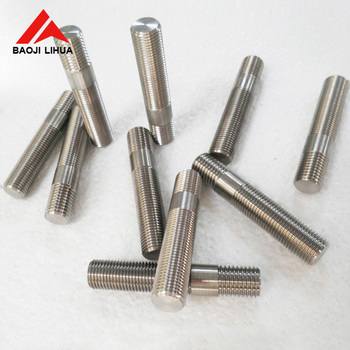
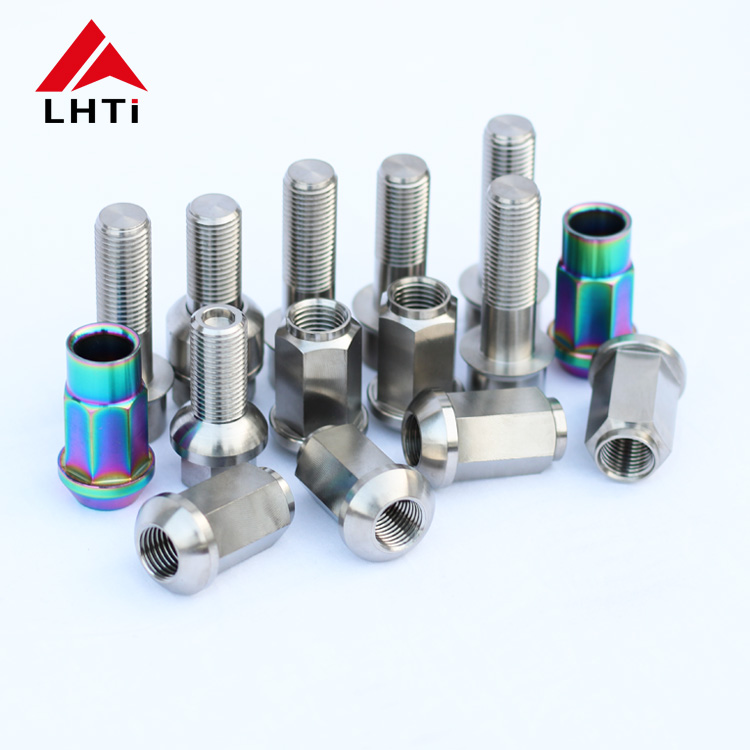
M8 × 1.25mm Titanium Exhaust Stud Kit
- Material Ti-6Al-4V Grade 5
- Length 38mm / 45mm / 50mm
- Head Type Hex Key / Torx Tip
- Hardware 12-Point Flange Nut
- Tensile ≥ 950 MPa
Addressing the core question asked by automotive aftermarket developers, performance racing tuners, and OEM powertrain teams: "Why do factory exhaust studs seize or shear, and does Grade 5 Titanium deliver measurable lifecycle superiority?"
In modern forced-induction, direct-injection, and high-compression internal combustion engines, exhaust manifold flanges endure some of the most unforgiving thermomechanical environments in mechanical engineering. Exhaust gas temperatures (EGT) routinely oscillate between ambient temperatures and 850°C to 1050°C at the exhaust port interface. Standard factory hardware—typically zinc-plated Grade 8.8 or Grade 10.9 carbon steel, or austenitic 304/316 stainless steel—invariably succumbs to thermal degradation, microscopic stress creep, thread embrittlement, or aggressive galvanic bonding with aluminum cylinder heads.
Jovzi Titanium Industry Co., Ltd. manufactures high-tensile Titanium Auto Exhaust Stud Bolts utilizing aerospace-grade Ti-6Al-4V (Grade 5, UNS R56400) bar stock certified to ASTM B348. Through precision cold-thread rolling and CNC machining in our Baoji facility, our titanium exhaust studs eliminate the two fatal vulnerabilities of conventional exhaust hardware: rust seizure and tension loss under severe thermal expansion mismatches.
Aluminum cylinder heads expand at roughly 23 × 10-6 / K, while cast iron or stainless steel manifolds expand at 11–17 × 10-6 / K. Standard carbon steel studs have low elasticity and a thermal coefficient of 12 × 10-6 / K. As the cylinder head expands under boost, steel studs are stretched past their plastic deformation point. When the engine cools down, clamp load drops to near zero, resulting in blown exhaust manifold gaskets, warped flanges, and audible exhaust leaks. Titanium Grade 5 possesses an elastic modulus of ~114 GPa (roughly half that of steel) combined with a yield strength exceeding 880 MPa. It acts as a heavy-duty mechanical spring, maintaining persistent clamping torque across rapid heating and cooling cycles without yielding or relaxing.
Unlike steel fasteners that suffer rapid oxidation and rust-fuse into cylinder head threads (requiring destructive drilling and thread tapping), titanium naturally forms a microscopic, passive titanium dioxide (TiO2) ceramic barrier. Titanium is completely immune to road salt, acidic exhaust condensation, and atmospheric corrosion.
Cheap market studs use cut threads that fracture the metal grain flow and introduce micro-stress risers. Jovzi titanium studs utilize 100% cold-rolled threads post-solution heat treatment. Rolled threads enhance fatigue endurance by over 300% and resist vibration loosening under extreme harmonic exhaust resonance.
With a density of only 4.43 g/cm³ compared to steel's 7.85 g/cm³, titanium fasteners reduce hardware weight by ~45%. For competitive motorsport, track cars, and endurance racing, replacing 16 to 24 exhaust and turbo manifold studs strips vital weight from above the engine's center of gravity.
Configured specifically for Japanese (JDM), European, and American performance powertrains. Available in standard kit configurations or manufactured custom to CAD drawings.
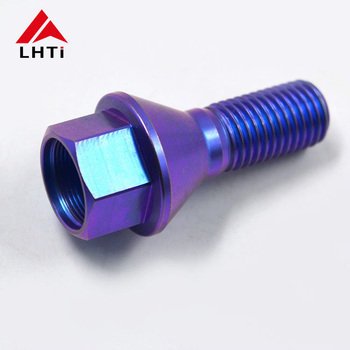
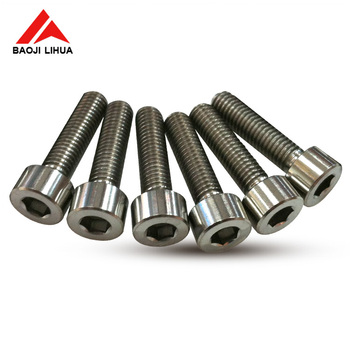
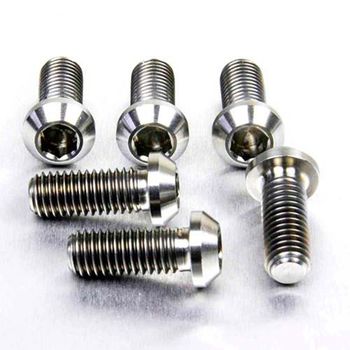
Looking for specific thread engagement lengths, stepped conversion studs (e.g., M10 block side to M8 nut side), or pre-anodized burnt rainbow finishes?
Get CatalogWhy Titanium Auto Exhaust Stud Bolts deliver optimal thermal-mechanical properties when benchmarked against carbon steel, stainless steel, and nickel-base alloys.
| Mechanical / Physical Property | Grade 5 Titanium (Ti-6Al-4V) | Grade 10.9 Carbon Steel | AISI 304 Stainless Steel | Inconel 718 (Nickel Superalloy) |
|---|---|---|---|---|
| Density (g/cm³) | 4.43 (Ultra-Light) | 7.85 | 7.93 | 8.19 (Heavy) |
| Tensile Strength (MPa) | 950 – 1,050 | 1,000 – 1,040 | 515 – 700 | 1,240 – 1,400 |
| Yield Strength Rp0.2 (MPa) | 880 – 950 | 900 – 940 | 205 – 350 | 1,030 – 1,100 |
| Modulus of Elasticity (GPa) | 110 – 114 (Spring Clamping) | 205 – 210 | 193 | 211 |
| Thermal Expansion (10⁻⁶/K) | 8.6 – 9.0 | 11.5 – 12.2 | 17.2 – 18.0 | 13.0 |
| Oxidation & Salt Corrosion | Immune (TiO₂ Passivated) | High Rust / Seizure Risk | Pitting / Stress Cracking | Immune |
| Ease of Extraction / Removal | Effortless (No galvanic fusion) | Prone to snapping | Galls without anti-seize | Good |
| Procurement Cost Factor | Balanced / Cost Effective | Lowest Initial Cost | Moderate | Extremely Expensive |
Data compiled by Jovzi Titanium Industry Co., Ltd. Metallurgical Lab. Material specifications conform to ASTM B348, ASTM A193, and AMS 5662 requirements.
How engine downsizing, hybrid turbocharging systems, and sustainable manufacturing are driving the global supply chain shift toward titanium exhaust hardware.
Global automotive emissions standards (such as Euro 7 and EPA Tier 4) have accelerated the adoption of downsized 3-cylinder and 4-cylinder engines operating under extreme boost pressure, alongside performance hybrid architectures. These powertrains experience rapid stop-and-go thermal cycles that induce profound thermal shock on exhaust studs. Conventional steel studs degrade rapidly under these duty cycles. Consequently, tier-one tuning suppliers and tier-two OEM performance divisions are standardizing on Grade 5 titanium exhaust stud bolt kits to guarantee zero-defect field reliability.
Automotive repair workshops and performance fabricators are calculating the real financial impact of snapped exhaust studs. When a steel stud rusts and breaks inside an aluminum cylinder head, extracting it requires 2 to 4 hours of professional machine-shop labor, welding extraction nuts, or EDM tap extraction—costing between $200 and $600 per incident. Upgrading to a premium set of Jovzi Titanium Auto Exhaust Stud Bolts eliminates 100% of broken stud extraction labor, delivering massive total-lifecycle cost savings for both workshops and vehicle owners.
Historically, titanium threads threaded into aluminum or paired with titanium nuts carried a risk of thread galling (cold-welding) if installed dry without lubrication. Product development is focusing heavily on surface modifications. At Jovzi Titanium Industry Co., Ltd., we offer micro-arc oxidation, molybdenum disulfide (MoS2) dry film coatings, and physical vapor deposition (PVD) titanium carbo-nitride (TiCN) treatments. These nanocoatings lower friction coefficients to μ = 0.10–0.12, ensuring repeatable torque preloading without galling, even without heavy wet paste lubricants.
While Grade 5 (Ti-6Al-4V) remains the global industry benchmark for operating temperatures up to 450°C–500°C at the cylinder head stud interface, high-output motorsport platforms (such as Formula drift, Le Mans GT, and WRC) are exploring high-temperature near-alpha and beta titanium alloys such as Ti-6242 (Ti-6Al-2Sn-4Zr-2Mo-0.1Si). These specialized alloys push continuous thermal resistance up to 550°C–600°C, offering exceptional creep resistance for direct turbo-to-manifold connections.
Established in 2006 in Baoji, Shaanxi Province (China's renowned "Titanium Valley"), Jovzi Titanium Industry Co., Ltd. specializes in the precision machining, cold forging, rolling, and global export of high-grade Titanium, Nickel, Tantalum, Molybdenum, and Tungsten components.
Backed by an annual production capacity exceeding 100 metric tons, our facility integrates advanced multi-axis CNC machining centers, high-speed thread-rolling units, and in-house spectral inspection. Our technical force includes 4 senior materials experts and 5 intermediate engineers dedicated to high-precision automotive fasteners, racing components, and industrial fittings.
Every shipment of Titanium Auto Exhaust Stud Bolts is backed by authentic mill test certificates issued by the authorized BaoTi Test Center, verifying exact chemical compositions, mechanical yield/tensile strength, and elongation conformity.
Addressing technical inquiries submitted by global procurement managers, engine builders, and automotive hardware distributors.
Whether you are sourcing standardized M8/M10 stud hardware kits for performance vehicle catalog distribution or need custom titanium racing fasteners manufactured to CAD drawings, our engineering team provides full technical proposals within 8 hours.